Our capital investment programme is delivering significant improvements to water infrastructure across the Cambridge Water region, helping to provide a reliable, resilient and sustainable water supply for our customers now and in the future.
As our communities grow and the impacts of climate change become more evident, investing in our water network has never been more important. Through a carefully planned programme of capital investment projects, we are upgrading essential assets, enhancing operational resilience and supporting environmental sustainability.
Investing for a better water future
Find out what else we're doing to create a better water future
Why we're investing
Water infrastructure plays a vital role in everyday life. From treatment works and pumping stations to water resources and water mains, these assets help ensure safe, high-quality drinking water keeps water flowing 24-hours a day, seven days a week to homes and businesses.
By investing today, we're helping to future-proof our network and ensure customers continue to receive a high-quality water service for generations to come.
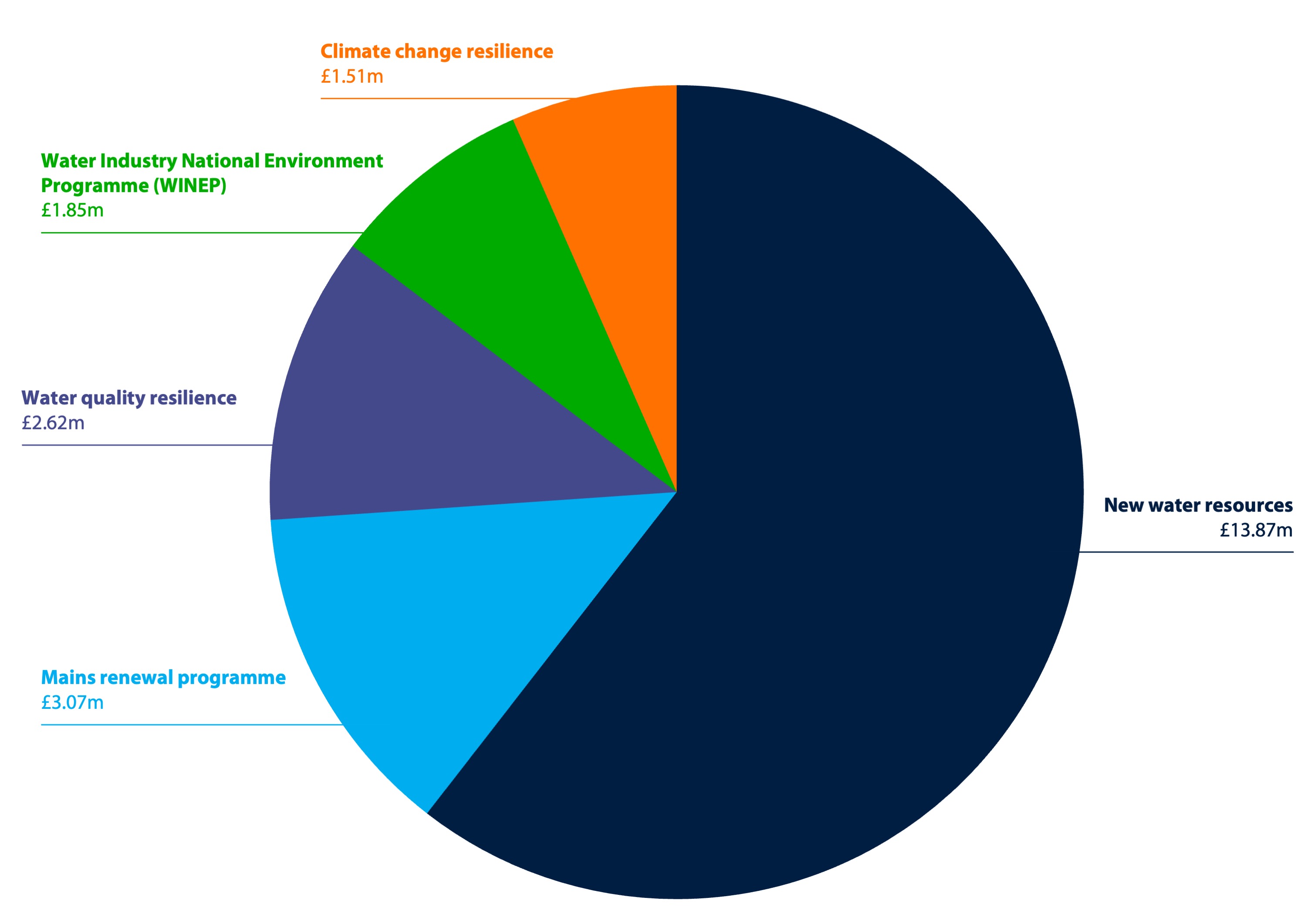
Key areas of investment
New water resources
Total investment (2025/26) - £13.87 million
To make sure we have enough water to supply our customers, we are investing in new water resources. These will allow us to capture and store more water before it is treated. Investment in this area includes bringing small reservoirs back into supply as well as new water storage.
Customer benefits
- A more reliable supply of water, especially during prolonged periods of dry weather.
- Greater resilience to drought and climate change.
- Improves the security of supply for future generations.
- Provides increased capacity, which meets the needs of a growing population.
Mains renewal programme
Total investment (2025/26) - £3.07 million
Between 2025-2030, we are replacing 250km of ageing pipework across our two supply regions (Cambridge Water and South Staffs Water), targeting areas of our network that have a history of bursting or leaking. This is the equivalent of replacing a pipeline from London to Manchester.
The selection of mains renewal schemes is driven by our asset management team. They review a range of different types of data – the key one being burst frequency. Next, the infrastructure programme manager reviews the analysis and provides an overview of deliverability and/or scheme extents.
This helps to extend each mains renewal project to make sure the renewed main covers the whole street, or we may connect to a section of previously renewed pipeline. This removes all ‘at risk’ mains and lowers the potential for return visits and future disruption for our customers.
Following this process enables us to understand where some schemes may be more challenging for our teams to deliver. This could be based on location, traffic sensitivity or customer impact. It also gives us the opportunity to engage with local authorities and other stakeholders on the planning and programme, making sure we manage expectations.
Total length of pipes replaced - 8,780m
Our team successfully delivered a complex mains renewal scheme across the neighbouring South Cambridgeshire villages of Harlton, Little Eversden and Haslingfield, helping to strengthen the local water network and reduce the risks of future bursts.
The project involved renewing or replacing 2,929m of water mains and service pipes across the three villages, with most of the work taking place on Harlton Road – the key route connecting these locations.
Work began on Washpit Lane in Harlton in October 2025 before progressing to Harlton Road in Little Eversden for a period of eight weeks. The final stage of the work began in January 2026 on Harlton Road, Church Street and Barton Road in Haslingfield, with the scheme completed in April 2026 within the timeframe communicated to customers. During delivery, the team also installed an additional 300m of pipework to further improve the network.
Throughout the duration of the scheme, maintaining access and minimising disruption in the local community was a key priority. Traffic management measures, including three-way traffic signals, temporary road closures and diversion routes, were carefully co-ordinated to help ensure work could be completed safely and efficiently while supporting local businesses.
A local wedding venue raised concerned about the potential impact of the works on business operations and customer experience. By working closely with the venue, our team ensured roads were open and tidy at key times, allowing guests and suppliers to access the site safely and on time. The team also worked flexibly to avoid disruption to local bus services, allowing vehicles to pass through the work area when it was safe to do so.
The local Parish Council had also raised previous concerns about recurring bursts in the area, and this scheme addressed its feedback. Through ongoing engagement before and during delivery of the works, the team demonstrated its commitment to listening to residents and investing where improvements were most needed. The successful completion of the project has strengthened the network, improved reliability and reduced the likelihood of future supply interruptions for our customers.
Customer benefits
Replacing ageing water mains and pipework delivers a range of direct and long-term benefits for customers:
- New pipes are less likely to fail, reducing the number of bursts, leaks and emergency repairs that can disrupt water supplies. This minimises unplanned water outages and reduces the inconvenience often caused by emergency works.
- A more modern infrastructure helps us to make sure customers continue to receive a consistent water supply, particularly during periods of high demand or extreme weather.
- New pipework will also help maintain water quality by reducing the risk of discolouration, sediment build-up and other issues associated with ageing infrastructure.
- Modern networks are often easier to monitor, isolate and repair, enabling quicker response times and reducing disruption to customers.
Water quality resilience
Total investment (2025/26) - £2.62 million
We're investing in improvements at six of our water treatment works to help make sure we continue to provide safe, clean, high-quality drinking water for our customers.
These upgrades will introduce ultraviolet (UV) disinfection technology alongside improvements to existing treatment processes. UV treatment provides an additional layer of protection against naturally occurring bacteria and other microorganisms that can be found in raw water sources.
This investment is part of our long-term commitment to maintaining a resilient and sustainable water network. It will help ensure our treatment facilities are equipped to meet future challenges and continue delivering a reliable supply of drinking water to customers for years to come.
Customer benefits
By enhancing our treatment facilities, we can:
- reduce the risk of water quality issues,
- improve the reliability of our treatment works, and
- help minimise unplanned interruptions to the water supply.
Water Industry National Environment Programme (WINEP)
Total investment (2025/26) - £1.85 million
Looking after the environment is a key part of what we do. As a water company, we have an important responsibility not only to provide reliable water services, but also to help protect and improve the natural environment for the communities we serve.
The UK Government has challenged water companies to deliver services that:
- Provide a safe, reliable and affordable water supply for customers today and for future generations.
- Help protect and enhance the environment, including cleaner rivers, healthier habitats and thriving wildlife.
- Deliver excellent customer service that people can trust.
- Support customers who may need extra help or assistance.
- Make decisions that benefit society, the environment and future generations in the long term.
Customer benefits
By investing in our infrastructure, protecting water resources and caring for the environment, we're helping to create a more sustainable future for our customers, communities and the natural world.
Our commitment to the brown trout projects is long-term and the programme is still in its early phase. Activity between 2025-26 has mainly focused on project feasibility, design and scoping.
We have still made some key achievements in this time:
- Match funded several smaller chalk streams projects which have started, delivered in partnership with local councils and the Wildlife Trust.
- Completed Phase 1 restoration measures on Mill River, a key part of our Water Resources Management Plan.
- Formed a partnership with the city council to agree a delivery approach for the city chalk streams in our programme, enabling effective and efficient delivery.
- Created a detailed scope of works and proposals for the seven chalk streams in our programme to commence delivery autumn-winter 2026 into spring/summer 2027.
Through a £27,000 PEBBLE grant, the Greater Cambridge Chalk Stream Project, led by Robert Martyr and Cambridge City Council, delivered practical habitat improvements across four urban chalk stream sites: Coldham’s Brook/East Cambridge Main Drain, Hobson’s Brook, Giant’s Grave and Nine Wells.
The funding was used exclusively for on-the-ground biodiversity enhancements, including bankside stabilisation, wetland planting, in-channel habitat creation, buffer zone improvements and springhead restoration. These works formed part of a wider city-wide restoration programme that has delivered 1,300 metres of in-channel restoration, 1,200 metres of bankside stabilisation, 2,400m² of habitat improvements and 1.4 hectares of springhead restoration.
A key strength of the project was its collaborative approach. Partners included Cambridge Water, Anglia Ruskin University, Aquamaintain, local community groups and volunteers, helping to combine technical expertise with long-term community stewardship. Volunteers contributed 368 hours of practical support, assisting with planting, habitat improvements, litter clearance and site preparation.
Despite challenges associated with urban waterways, including restricted access, sediment build-up and ecological constraints, the project successfully delivered visible environmental improvements. Early benefits include more diverse habitats, stronger banks, improved ecological connectivity and better conditions for wildlife and vegetation recovery.
The project has demonstrated that even highly modified urban chalk streams can recover when evidence-led restoration, practical habitat improvements and community involvement are brought together.
The future
The PEBBLE-funded improvements are expected to deliver long-term benefits by creating more diverse and resilient chalk stream habitats and supporting a wider range of plants, invertebrates, amphibians, birds and other wildlife.
As restored areas mature, they will strengthen the wider chalk stream ecosystem and improve habitat connectivity.
The project has also provided a strong foundation for future restoration work across Cambridge, demonstrating how targeted local interventions, community involvement and long-term management can contribute to large-scale environmental recovery.
The success of this first phase has helped unlock a much larger Phase 2 restoration programme, creating a lasting legacy from the PEBBLE investment.
Climate change resilience
Total investment (2025/26) - £1.51 million